Starting a business is one of the most powerful financial decisions you can make. But before investing your hard-earned money, one major question arises:
Should you buy a franchise or start your own business from scratch?
Both paths offer exciting opportunities — and serious challenges. The right choice depends on your personality, experience level, financial strength, and long-term goals.
In this comprehensive guide, we’ll break down the key differences, advantages, disadvantages, costs, risks, and profitability factors to help you decide what’s better for you.

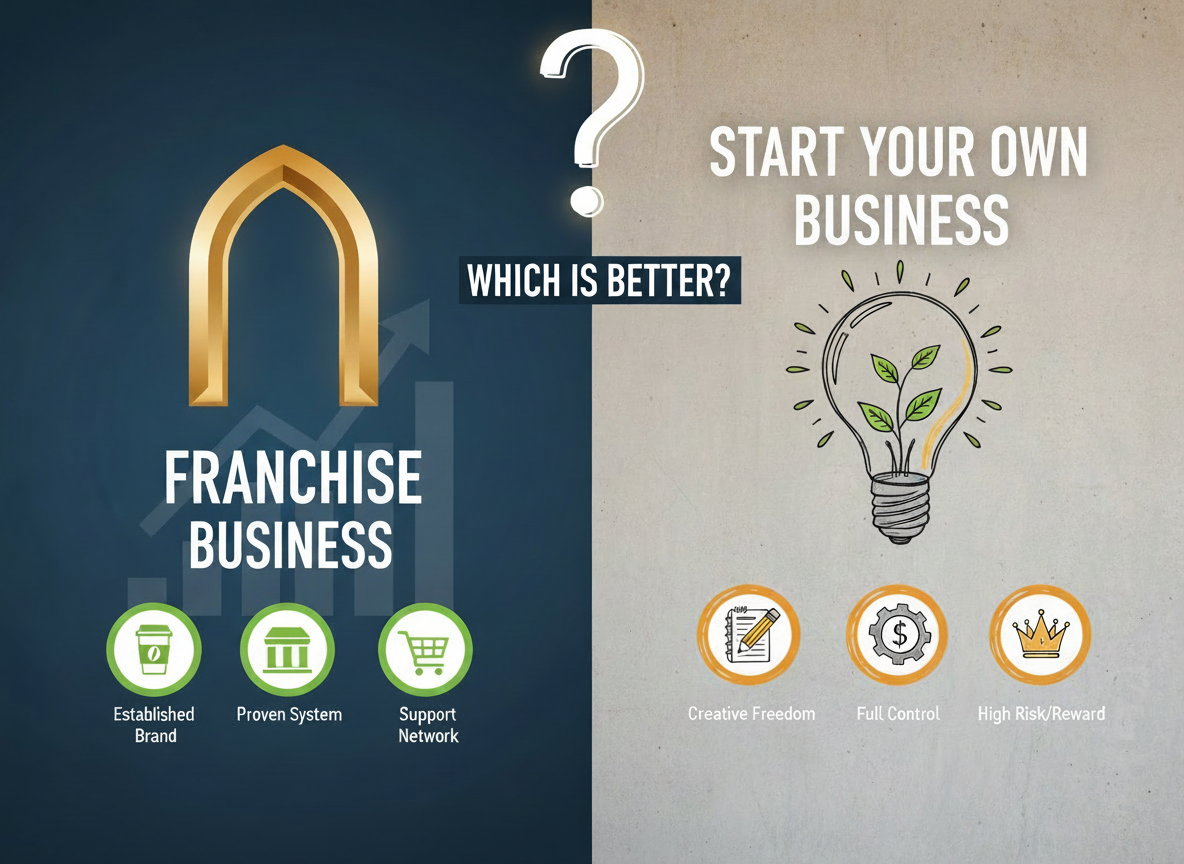
Starting a business is a major financial and life decision, and one of the biggest questions aspiring entrepreneurs face is whether to buy a franchise or build their own business from scratch. A franchise allows you to operate under an established brand with a proven system, giving you structured support, training, and immediate brand recognition. This significantly reduces the trial-and-error phase and lowers the risk compared to launching a completely new concept. However, franchising comes with limitations such as royalty fees, strict operational guidelines, and reduced creative freedom. On the other hand, starting your own business gives you full control over branding, pricing, strategy, and expansion. You keep all the profits and build your own identity in the market, but you also carry the full risk and responsibility of success or failure. While franchises are generally better suited for first-time business owners seeking stability and guidance, independent businesses often appeal to experienced or highly creative entrepreneurs who value flexibility and long-term scalability. Ultimately, the better choice depends on your financial capacity, risk appetite, experience level, and vision for growth. Both paths can lead to success if aligned with the right mindset and strategic planning.
When you buy a franchise, you are investing in a business model that has already been tested in the market. The brand is usually recognized, the products or services are standardized, and the operational systems are already developed. This significantly reduces the uncertainty that comes with starting a completely new venture. Franchise owners typically receive training, marketing support, supplier connections, and ongoing operational guidance from the parent company. This makes franchising particularly attractive for first-time entrepreneurs who may not have deep business experience. Because the brand already has credibility, attracting customers becomes easier compared to launching an unknown brand.
However, franchising is not without limitations. As a franchisee, you must follow the rules and systems set by the franchisor. This includes store design, pricing structure, marketing guidelines, supplier selection, and sometimes even hiring policies. You also have to pay an initial franchise fee along with ongoing royalty payments, which can reduce your overall profit margins. If you are someone who values creativity and full decision-making power, these restrictions may feel limiting. Additionally, the success of your business is partially dependent on the overall brand reputation. If the brand faces negative publicity, it can directly affect your outlet as well.
On the other hand, starting your own business gives you complete control over every aspect of operations. You create your own brand identity, set your own pricing strategy, choose your suppliers, and design your own marketing campaigns. There are no royalty payments, meaning you keep all the profits after expenses. This model offers greater long-term flexibility and scalability because you are not bound by corporate rules. If your concept succeeds, you can even expand and franchise your own brand in the future.
However, building a business from scratch carries higher risk. There is no guaranteed customer base, no established systems, and no brand recognition. You must invest time and money into market research, product development, branding, marketing, and operational planning. Mistakes in the early stages can be costly, and it may take longer to reach profitability. Success depends entirely on your ability to execute your idea effectively and adapt to market changes.
Financially, franchises often require higher upfront investments due to franchise fees and setup standards, but they may offer more predictable returns. Independent businesses can sometimes be started with lower capital depending on the concept, but revenue growth may be slower in the beginning. Your access to funding and financial stability should play a major role in your decision.
Experience level is another important factor. If you are new to entrepreneurship and prefer structured guidance, a franchise may provide the support system you need. If you have industry experience, strong leadership skills, and a clear vision, building your own business might offer greater long-term satisfaction and financial rewards.
Ultimately, there is no universal “better” option. The right choice depends on your personality, risk appetite, financial strength, and long-term goals. If you prefer security, brand recognition, and a proven system, franchising could be the smarter route. If you value independence, innovation, and complete ownership, starting your own business may be more fulfilling. Both paths have created highly successful entrepreneurs. The key is aligning your choice with your strengths, resources, and vision for the future.